How ectomycorrhizal symbiosis connects mushrooms and trees
Most prized woodland mushrooms are not independent plants feeding on soil alone. They are the fruiting bodies of ectomycorrhizal fungi whose underground threads, called hyphae, wrap around the fine root tips of living trees to form a tight sheath and extend outward into the surrounding forest floor.
This partnership works through a straightforward nutrient exchange. Fungal hyphae reach into tiny soil pores to collect water and mineral nutrients such as phosphorus and nitrogen that tree roots struggle to absorb on their own. In return, the tree converts sunlight into sugars through photosynthesis and supplies part of those carbohydrates to the fungus. While forest soils contain overlapping mycelial threads, where and when mushrooms fruit depends primarily on this direct root-level trade, soil moisture, and stand conditions rather than dramatic underground signaling.
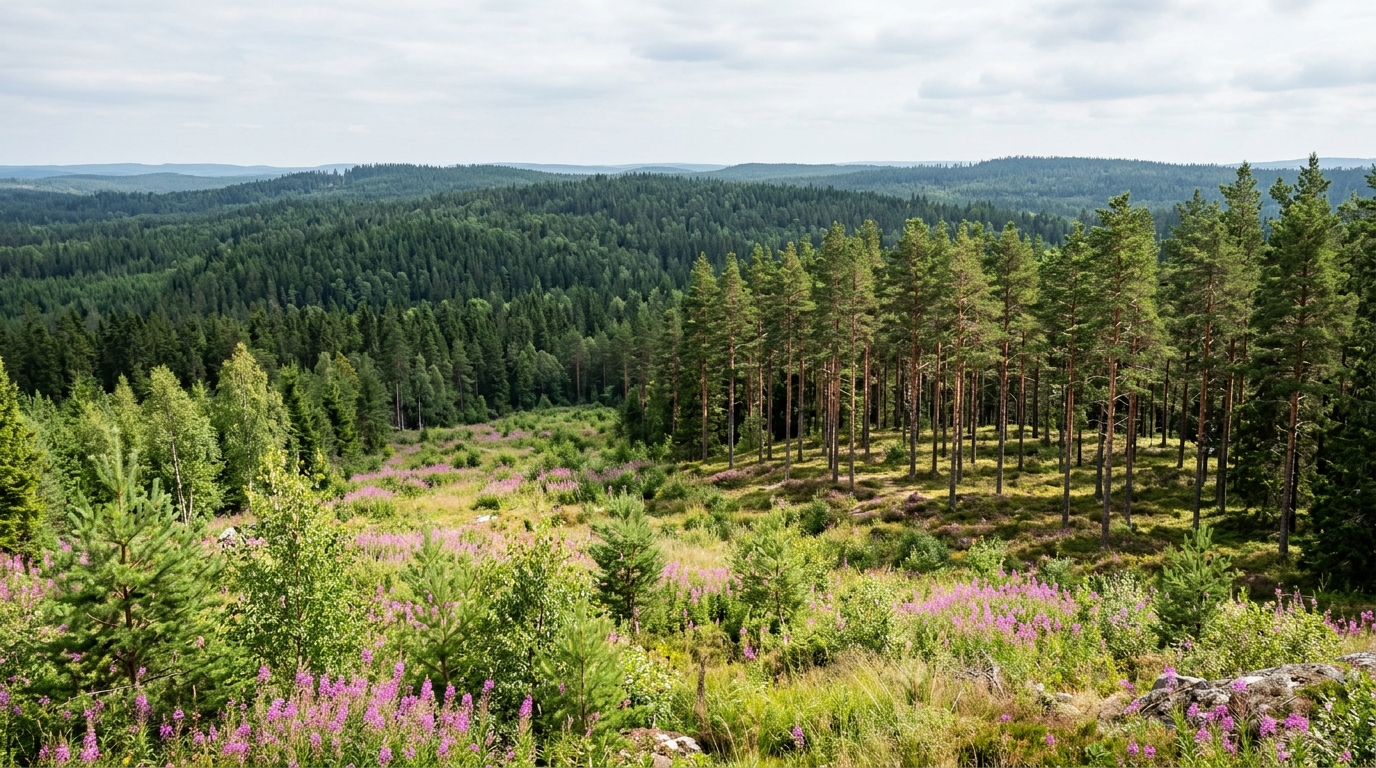
Because the underground mycelium persists across seasons as long as its host trees stay alive, productive mushroom spots often fruit in the same patches year after year when rain and temperature align. By contrast, clear-cutting all host trees cuts off the fungus's sugar supply, halting mycorrhizal fruiting until a new canopy establishes.
Conifer partners: Scots pine and Norway spruce
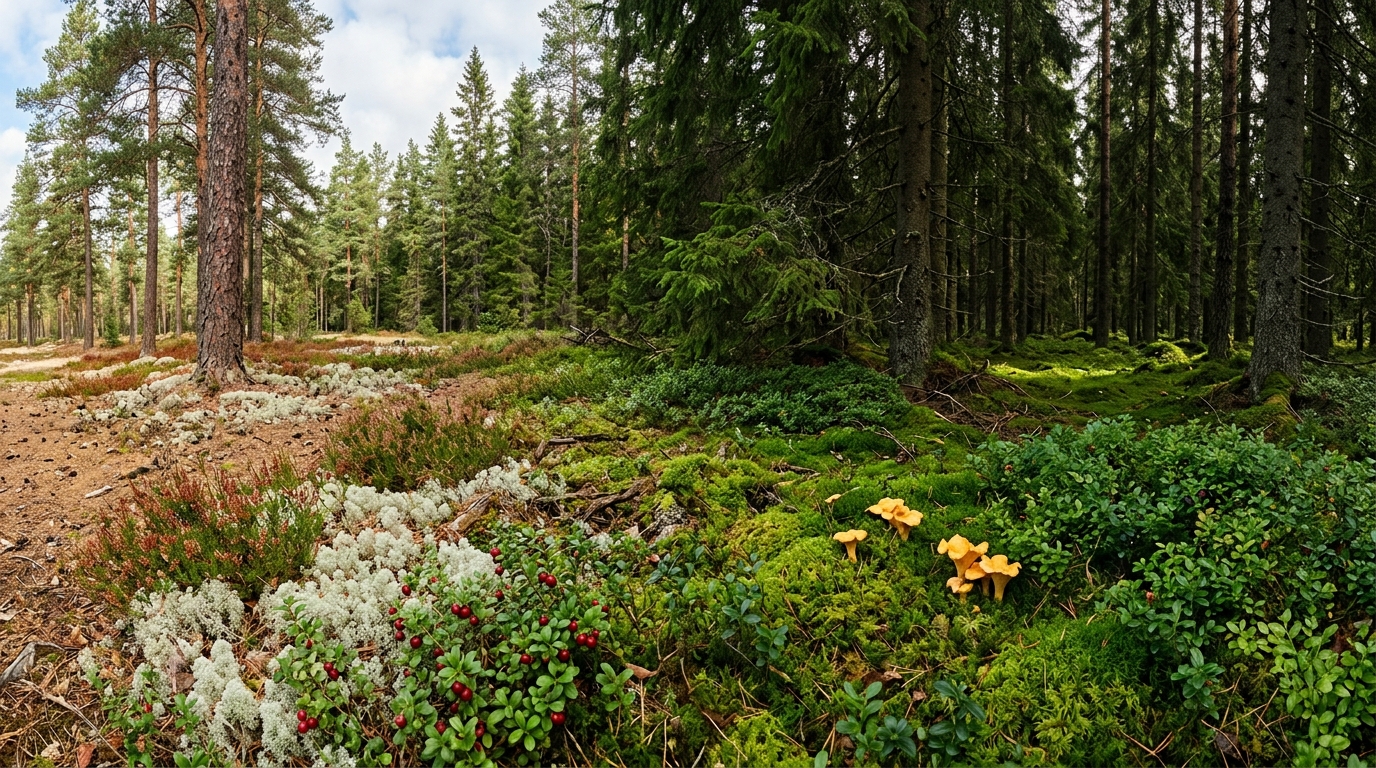
Coniferous woodlands across northern and central Europe yield dependable harvests, yet pine and spruce support clearly different fungal communities. Scots pine (Pinus sylvestris) thrives on drier, well-drained sandy soils and lets more sunlight reach the forest floor, whereas Norway spruce (Picea abies) casts deep shade over cool, moist needle beds and thick feather moss.
Some fungi adapt to both conifers, while strict specialists appear only where their preferred tree genus dominates. Knowing whether you are standing under pine or spruce immediately narrows down which boletes and milk caps you can expect to find.
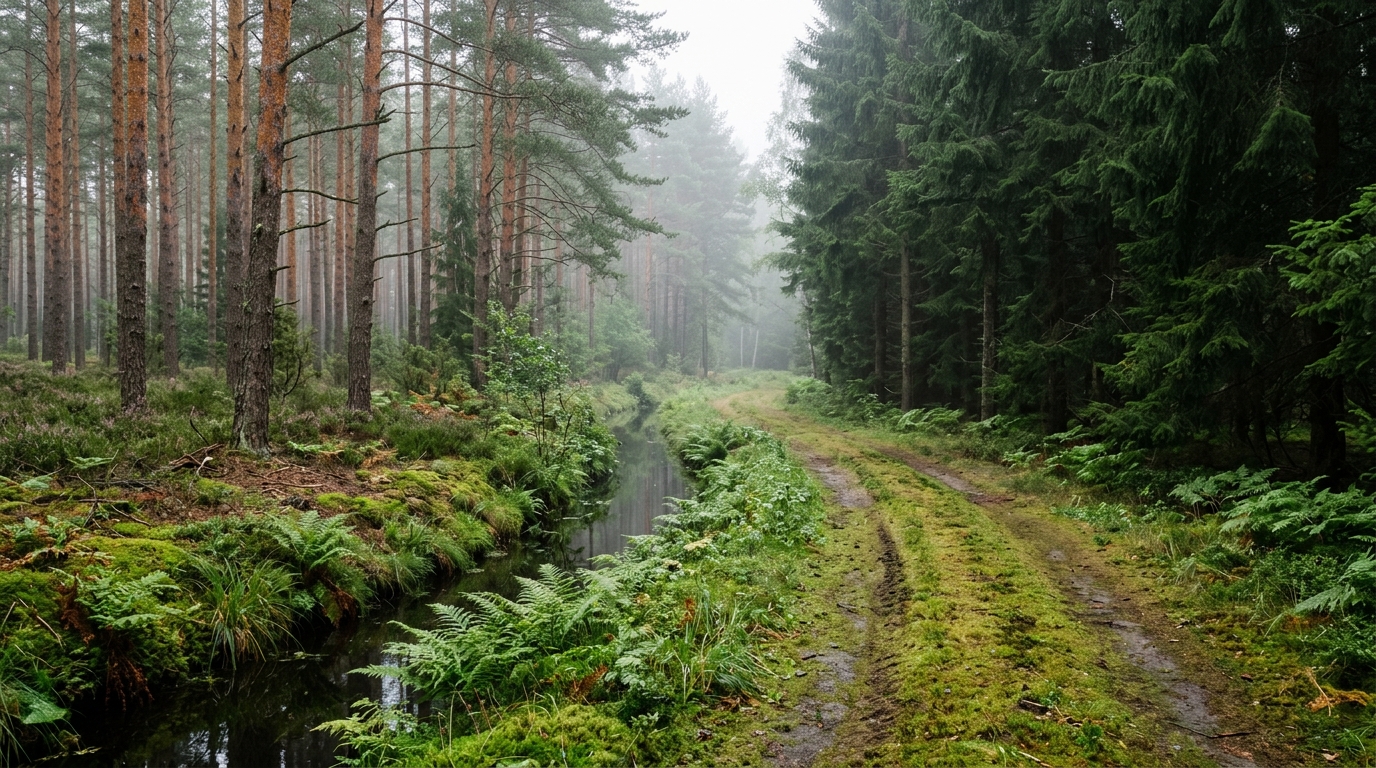
Microhabitat details inside conifer stands sharpen those predictions further. Acidic, feather-moss spruce floors behave very differently from dry, lichen-covered pine ridges, while compacted edges along forest tracks often trigger earlier flushes where rainwater collects and sunlight warms the topsoil.
- Scots pine specialists: pine bolete (Boletus pinophilus), saffron milk cap (Lactarius deliciosus), and slippery jack (Suillus luteus), especially along sunlit rides and lichen-covered ridges.
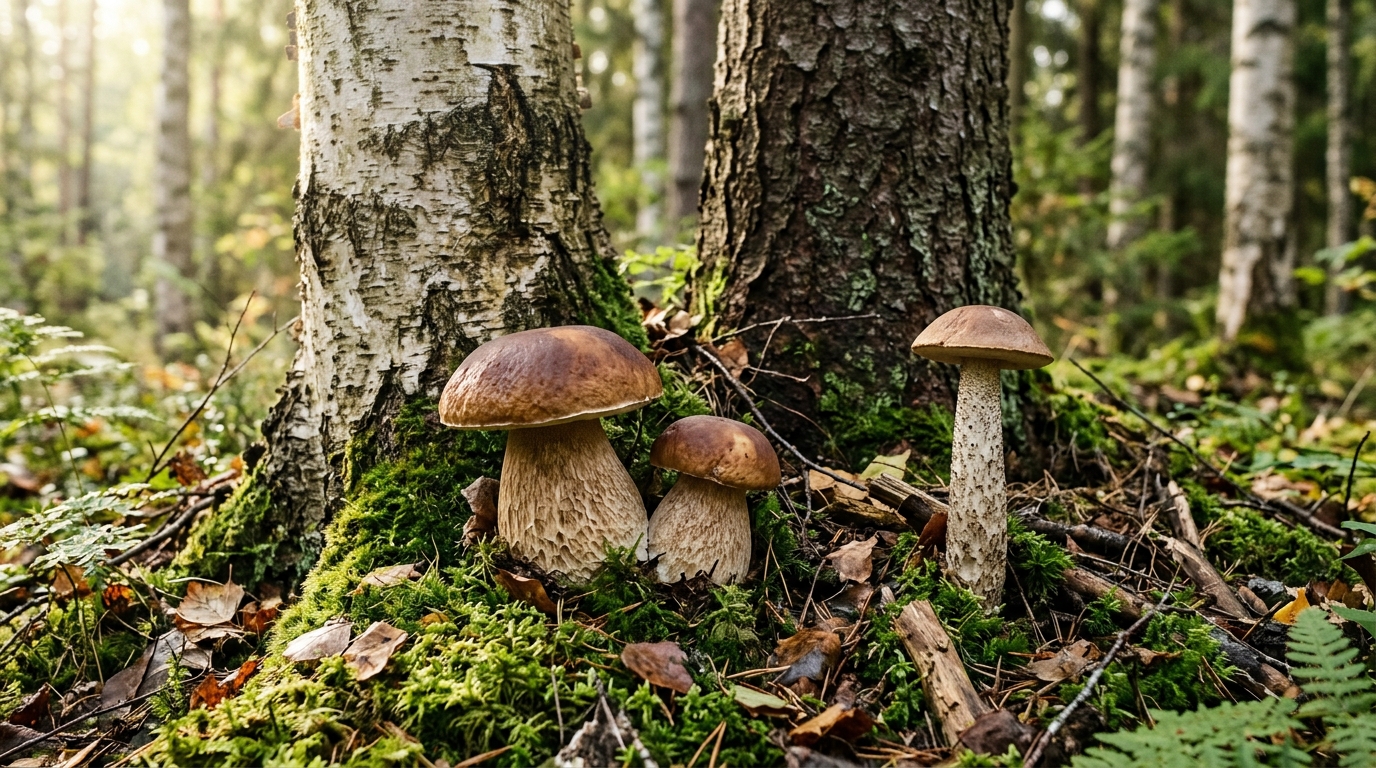
- Norway spruce partners: king bolete or penny bun (Boletus edulis) and false saffron milk cap (Lactarius deterrimus) tucked into cool, mossy interiors.
- Shared conifer favorites: golden chanterelle (Cantharellus cibarius) and wood hedgehog (Hydnum repandum), particularly where spruce and pine mix with scattered birch.
- Stand age influence: slippery jacks and milk caps frequently fruit in young pine or spruce stands, while Boletus edulis and pine boletes reach peak production in mature forests.
Broadleaf pioneers: silver birch, downy birch, and aspen
Fast-growing broadleaf trees such as silver birch (Betula pendula), downy birch (Betula pubescens), and European aspen (Populus tremula) colonize forest edges, clearings, and mixed conifer woodlands. Many boletes in genus Leccinum are remarkably loyal to these pioneer trees, making basic bark and leaf recognition one of the fastest field shortcuts in mushroom identification.
Even in a forest dominated by pine or spruce, a narrow belt of birches along a wet ditch or an isolated grove of aspens on a richer slope can trigger an entirely separate flush of mushrooms just steps away from conifer habitat.
- Birch specialists: brown birch bolete (Leccinum scabrum) and orange birch bolete (Leccinum versipelle), often sharing mossy borders with golden chanterelles.
- Aspen partner: red-capped aspen bolete (Leccinum aurantiacum), easiest to spot beneath mature aspens with trembling leaves and pale greenish-grey bark.
- Mixed birch-conifer edges: fly agaric (Amanita muscaria) often fruits alongside birch and spruce at the same time as Boletus edulis, acting as a visible cue that mycorrhizal fungi are active.
Oak, beech, and hazel: rich temperate mushroom habitats
Across western and central Europe, and on warmer calcareous or loamy pockets further north, European beech (Fagus sylvatica), pedunculate and sessile oak (Quercus robur and Quercus petraea), and common hazel (Corylus avellana) form complex deciduous canopies. Their leaf litter breaks down into nutrient-rich humus that retains moisture well into autumn.
Warm summer storms followed by mild nights often wake up deep mycelial mats under old oaks and beeches earlier in the season than in boreal spruce forests, producing heavy flushes on slopes and sheltered valley floors.
- Oak and beech boletes: summer cep (Boletus reticulatus) during warm mid-summer spells, followed by classic Boletus edulis later in autumn.
- Camouflaged woodland gems: black trumpet (Craterellus cornucopioides) blending into dark fallen beech and oak leaves, alongside bright chanterelles on mossy banks.
- Hazel understory associates: common hazel forms ectomycorrhiza with species such as fiery milkcap (Lactarius pyrogalus), chanterelles, and limestone-loving truffle fungi.
Saprotrophic and parasitic mushrooms: why wood-dwellers ignore host rules
Not every forest mushroom relies on a living tree partner. Saprotrophic fungi obtain their carbon by decomposing dead organic material such as fallen trunks, rotting stumps, buried wood fragments, and thick leaf litter. Because they do not trade sugars with living roots, their presence follows the tree species and decay stage of the dead wood rather than the health of the living canopy.
Oyster mushrooms (Pleurotus ostreatus) are classic saprotrophs that fruit on dead broadleaf logs and standing snags—especially beech, poplar, and birch—from late autumn through mild winter thaws. Honey fungus (Armillaria species) straddles both worlds: it spreads through black, root-like rhizomorphs to decay stumps while also acting as a parasite capable of colonizing weakened living conifers and broadleaves.
For foragers, separating saprotrophs from mycorrhizal species explains why logs and old stumps remain productive long after a tree falls, even during mild spells outside the main autumn season. Meanwhile, true mycorrhizal mushrooms like porcini and chanterelles disappear from fresh clearings once living host roots die back.
Deadly lookalikes share the exact same host trees
Knowing tree partnerships is an indispensable navigation tool, yet it never guarantees edibility because dangerous toxic mushrooms are often ectomycorrhizal too. The death cap (Amanita phalloides), responsible for most fatal mushroom poisonings in Europe, lives in symbiosis mainly with oak and beech, and sometimes with birch, hazel, or hornbeam—the very trees that shelter summer ceps, chanterelles, and edible brittlegills.
Deadly webcaps such as Cortinarius rubellus and Cortinarius orellanus likewise associate with conifers and broadleaves in ordinary foraging woods. Always inspect gills or pores, spore color, stem ring, and basal volva on every single specimen, and consult a local mushroom expert or verified field guide if any detail is uncertain.
Good field habits protect you far better than host-tree rules alone. Lift mature specimens carefully to inspect the full stem base, keep any uncertain mushroom separated from your main basket, and verify identifications against regional field guides or local mushroom inspection services before cooking.
How Atveria maps dominant tree species per forest stand
Walking randomly through large tracts of woodland wastes energy when your target mushroom is tied to one host tree that only covers small ridges or riverbanks. Public forestry inventories record the dominant tree species, secondary canopy composition, stand age, and site type for individual forest stands, turning botanical knowledge into clear route planning.
On the Atveria map, you can inspect which tree species dominate each public forest stand across 13 European countries and filter habitats for pine, spruce, birch, aspen, oak, beech, or mixed stands before heading out. Pairing host tree distribution with stand age and site moisture lets you focus your walk on ecologically suitable terrain and verify conditions directly on the forest floor.