What Is a Forest Site Type?
When foresters walk into a woodland, they do not just see trees. They look at the soil, moisture regime, and the carpet of mosses, dwarf shrubs, and herbs on the forest floor. In Northern and Baltic forestry—building on Finnish botanist A. K. Cajander's classic forest type theory—stands with similar growing conditions are grouped into forest site types.
Because trees and wild fungi share the same soil chemistry and water balance, site type is one of the strongest clues for where mushrooms and berries actually fruit. Two pine forests only a kilometre apart can yield completely different harvests if one sits on dry, nutrient-poor sand and the other on moist, loamy moraine.
Dry Lichen and Heather Pine Forests
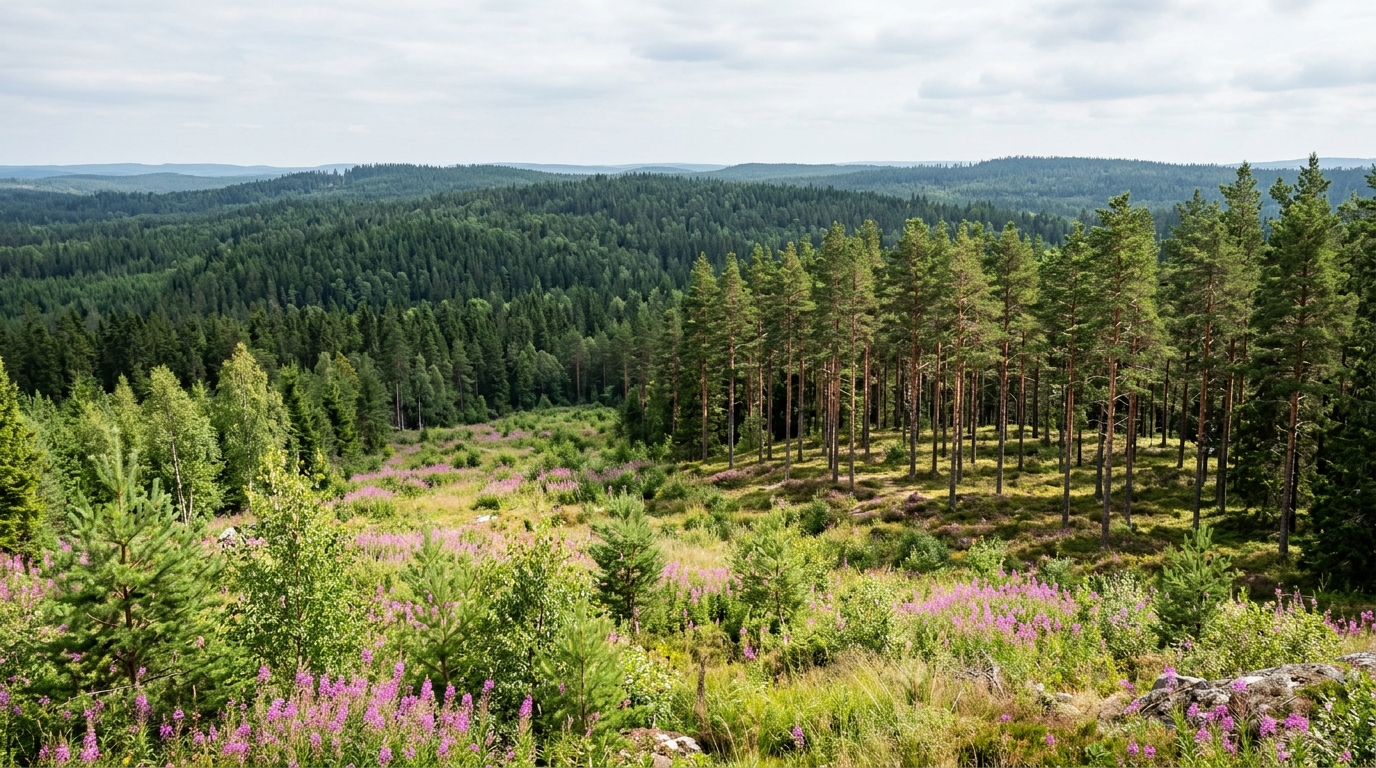
At the driest, most nutrient-poor end of the spectrum lie lichen and heather site types, typically dominated by Scots pine on sandy ridges, glacial eskers, or coastal dunes. Sunlight reaches the ground easily, and rainwater drains quickly through coarse sand.
These open, airy stands warm up rapidly in spring and early autumn, though they also dry out fastest during heatwaves. Foragers visit them after steady autumn rains for classic pine-associated species and sun-loving berries.
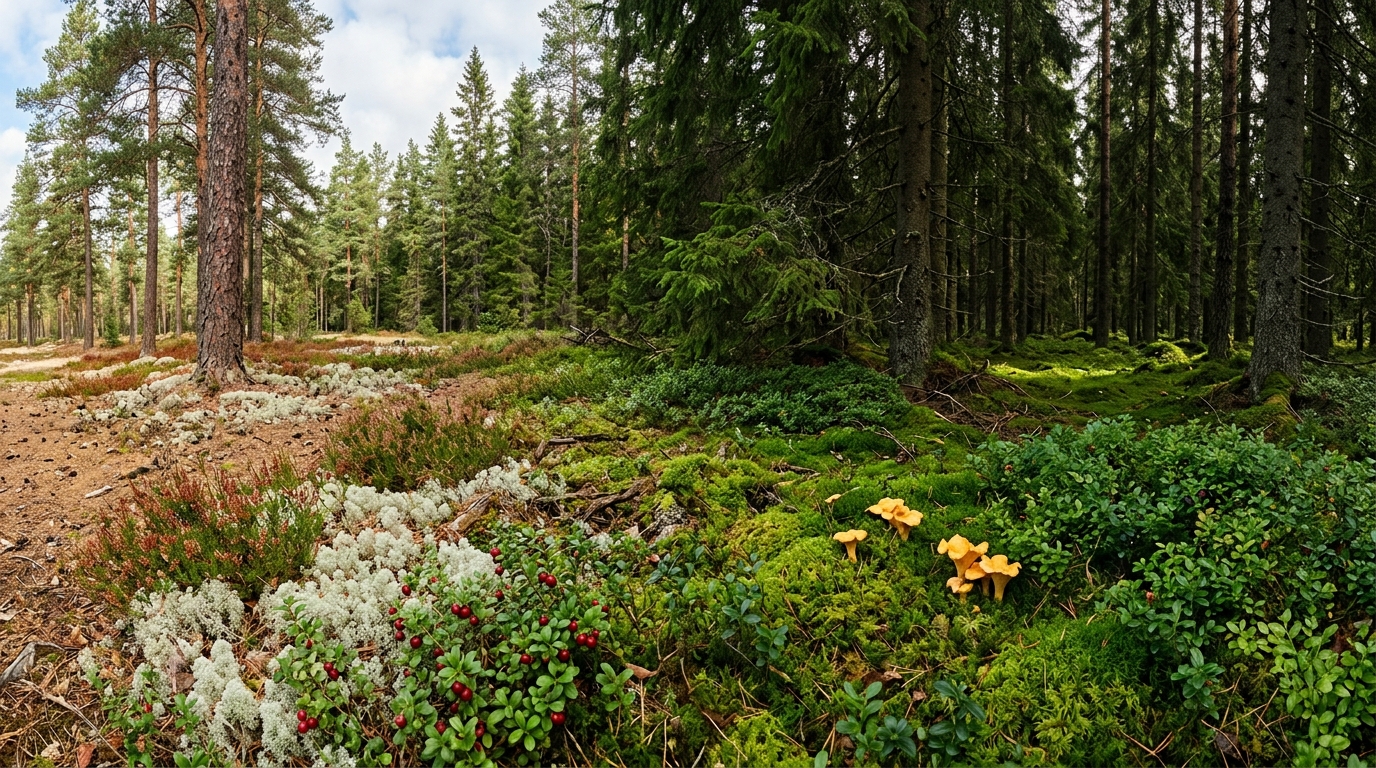
- Indicator plants: reindeer lichen (Cladonia), heather (Calluna vulgaris), bearberry, and scattered cowberry.
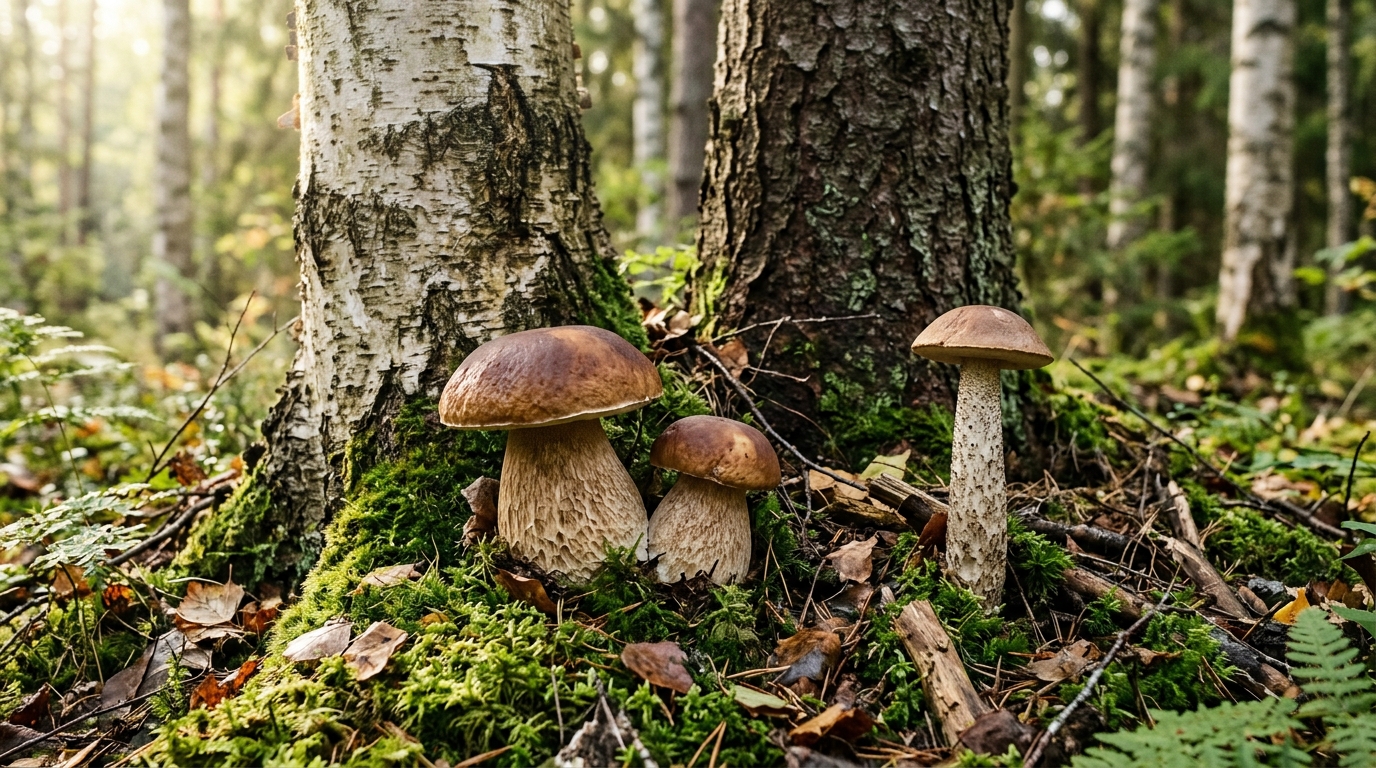
- Typical harvest: lingonberries on sunny edges, pine boletes (Boletus pinophilus), slippery jacks (Suillus luteus), and sheep polypores in sandy pine stands.
Dry-Fresh Lingonberry and Fresh Bilberry Types
Move slightly downslope or onto finer mineral soil and moisture retention improves dramatically. Lingonberry (Vaccinium vitis-idaea) and bilberry (Vaccinium myrtillus) site types form the backbone of productive Nordic and Baltic foraging forests.
In fresh bilberry types, a continuous feather-moss carpet—dominated by Pleurozium schreberi and Hylocomium splendens—acts like a sponge, buffering temperature swings and holding moisture for weeks after rainfall. Scots pine, Norway spruce, and silver birch thrive together here, creating ideal mycorrhizal diversity.
- Indicator plants: dense bilberry shrubs, lingonberry, feather mosses, and occasional lily-of-the-valley or twinflower.
- Typical harvest: golden chanterelles (Cantharellus cibarius), penny buns (Boletus edulis), spruce milk caps, and abundant wild bilberries.
Rich Herb-Rich and Wood-Sorrel Spruce Forests
On fertile, well-drained loams and calcareous soils, shrubs give way to broadleaf herbs and ferns. Wood-sorrel (Oxalis acetosella), liverleaf (Hepatica nobilis), wild strawberry, and tall ferns signal high nutrient availability and faster litter decomposition.
Because the canopy of Norway spruce, birch, aspen, or oak casts deeper shade, these stands stay cool during dry summers. Autumn brings a rich variety of fungi that prefer calcium-rich or humus-rich soils rather than acidic sand.
- Indicator plants: wood-sorrel, anemone, broadleaf grasses, and lush fern patches.
- Typical harvest: hedgehog mushrooms (Hydnum repandum), black trumpets (Craterellus cornucopioides), hazel-associated species, and diverse milk caps.
Paludified Forests and Peatland Bogs
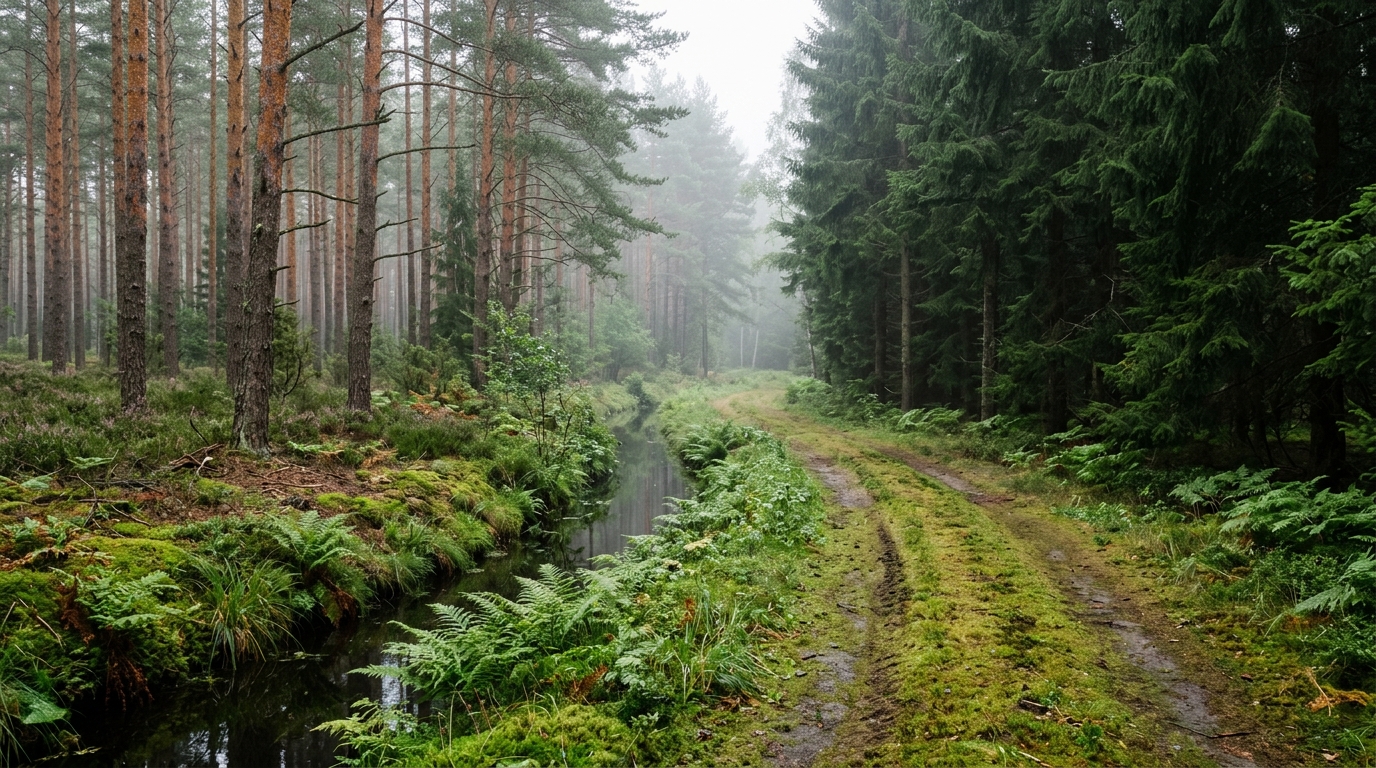
Where drainage slows down, peat accumulates and Sphagnum mosses take over. Paludified spruce and pine forests bridge the gap between mineral soil and open raised bogs. The microclimate is cool, humid, and acidic.
While mineral-soil mushrooms thin out as water tables rise, wet edges and open peatlands become irreplaceable for northern berries and late-season moisture-loving fungi.
- Indicator plants: Sphagnum moss, Labrador tea (Rhododendron tomentosum), bog bilberry, and cotton grass.
- Typical harvest: cloudberries (Rubus chamaemorus) on hummocks, bog cranberries (Vaccinium oxycoccos) in wet hollows, and yellowfoot chanterelles on mossy hummock margins.
Reading Site Types on the Atveria Map
Learning to read ground vegetation takes seasons in the field, yet national forest inventories already classify millions of stands by site type, dominant tree species, and stand age. Knowing the site type before leaving home saves hours of walking through unsuitable terrain.
On Atveria, each foraging species is matched against real forest-register site types and host trees so you can see high-potential stands directly on the map and focus your walk on public forests that fit the species you are looking for.