From Thaw to Budburst: Tapping Birch Sap Safely
Spring foraging in European forests begins well before the canopy turns green. As daytime temperatures climb above freezing after winter, silver and downy birches pump mineral-rich sap upward from thawed roots toward swelling buds. This sweet, slightly woody liquid flows only during a brief window lasting two to three weeks between snowmelt and budburst. Once leaves begin to open, the sap turns cloudy and bitter, signalling the end of the harvest.
Tapping requires restraint and care for the living tree. Choose a healthy, mature birch at least twenty centimetres in diameter, drill a narrow shallow hole a few centimetres deep on the sunny side, and collect only a modest amount from a single tree. When finished, seal the hole snugly with a clean wooden peg made from birch or willow so fungi and insects cannot enter.
Before carrying a drill into the woods, always verify local regulations and ownership rules. In many European countries, even public access laws do not permit drilling or damaging living trees without the landowner's explicit consent, and state forestry agencies often set strict guidelines.
- Tap only mature trees with thick bark and never drill the same birch two years in a row.
- Keep holes narrow and shallow, usually three to four centimetres deep, and plug them cleanly afterwards.
- Confirm national forestry rules or obtain written landowner permission before tapping any tree.
Wild Garlic in Moist Broadleaf Woods and Deadly Lookalikes
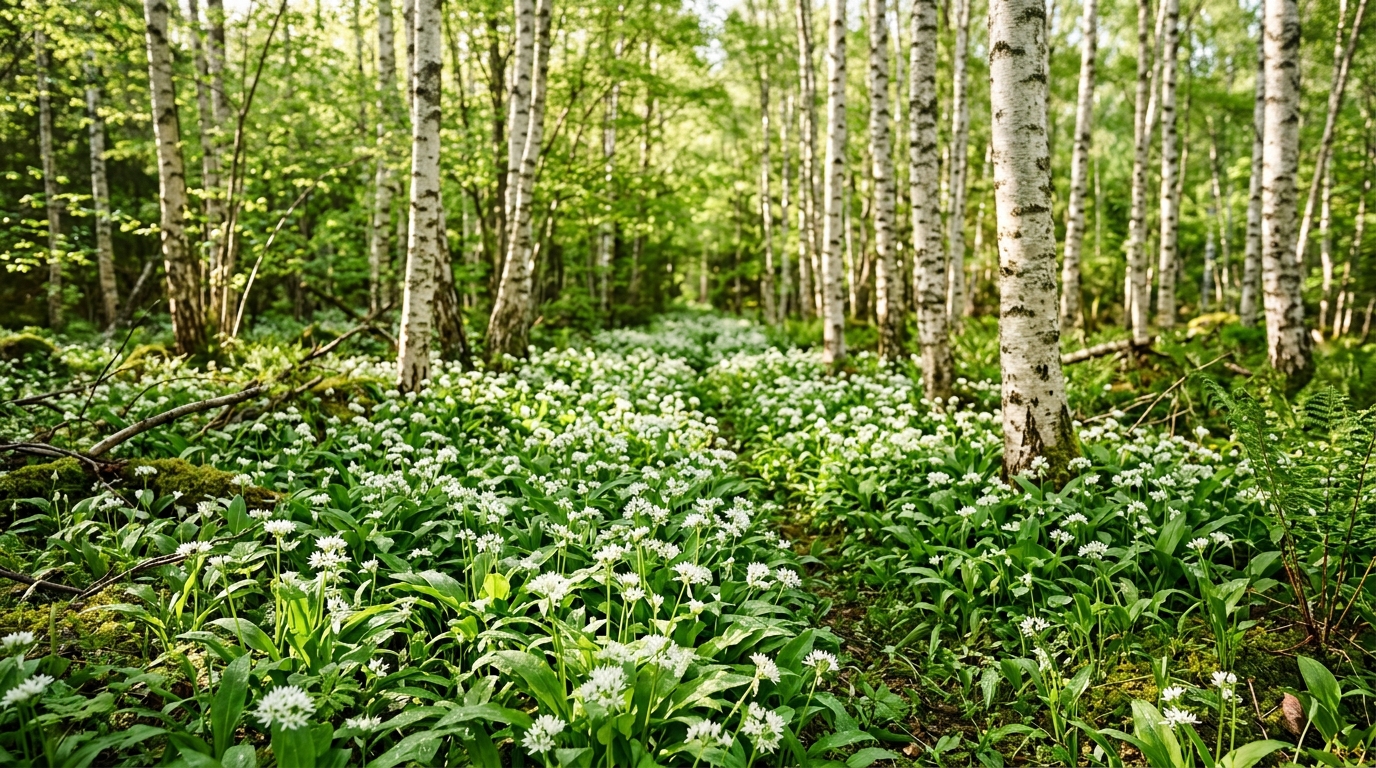
Soon after the birch sap slows, carpets of wild garlic, also known as ramsons (Allium ursinum), unfurl across damp, humus-rich broadleaf and mixed forests. Look for it along shaded stream valleys, calcareous slopes, and old ash, beech, or alder stands where soils remain cool and fertile. Picking just one or two leaves per plant preserves dense colonies for future seasons.
Wild garlic demands strict botanical attention because two dangerously toxic plants share the exact same spring woodland floor and similar lance-shaped green leaves: lily-of-the-valley (Convallaria majalis) and autumn crocus (Colchicum autumnale). Both contain potent toxins that can cause fatal poisoning even in small quantities. Never grab handfuls blindly; inspect every single leaf individually before placing it in your basket, and wash hands after testing suspect leaves.
Remember that a strong garlic scent on your fingers can linger and fool you on the next plant. Step away to fresh air if needed, and examine the underside, texture, and growth habit of each stem. Wild garlic grows single leaves on distinct slender petioles, whereas lookalikes wrap around one another.
- Scent check: crushed Allium ursinum smells unmistakably of garlic, while lily-of-the-valley and autumn crocus have no garlic aroma.
- Leaf texture: wild garlic leaves are soft, matte underneath, and snap cleanly along a clear central midrib.
- Growth habit: ramsons send up individual leaf stalks from a narrow bulb; lily-of-the-valley shoots clasp together in pairs.
- Autumn crocus warning: Colchicum autumnale grows stiffer, glossy, strap-like leaves in a basal rosette without stems.
Young Norway Spruce Tips: Bright Forest Citrus
As April turns into May, Norway spruce (Picea abies) branches light up with lime-green buds shedding their papery brown caps. These soft, tender spring shoots carry a bright, resinous citrus note alongside vitamin C and aromatic oils. Harvest only the soft new growth when the needles are still pliable and pale green, before the shoot darkens and stiffens for summer.
Responsible picking keeps young trees healthy and shapely. Never snap off the leading top shoot of a spruce, because removing the central crown stunts vertical growth and ruins timber form. Instead, pinch just a handful of side tips from lower, sun-warmed branches on different mature trees, leaving most new buds intact so each branch can continue extending normally.
As with tree sap, check local forest rules before gathering spruce shoots, since clipping living conifer tips is classified as damaging tree growth in several jurisdictions without permission. Enjoy fresh tips steeped in warm water, infused into syrup, or chopped over roasted vegetables.
True Morels vs False Morels in Spring Forests
Late spring brings the year's most sought-after fungi: true morels (Morchella species). These hollow, honeycomb-capped mushrooms favour sunlit, moisture-retentive soils rich in calcium and minerals. Foragers often find them near old ash, elm, and apple trees, along calcareous woodland edges, riverbanks, and recently disturbed or burned ground where competing vegetation has opened up.
At the same time, dry sandy pine forests and clearings harbour the notorious false morel (Gyromitra esculenta). Although traditionally parboiled in a few northern regions, Gyromitra esculenta contains gyromitrin, a volatile toxin linked to severe liver and neurological poisoning. Health authorities across Europe advise against eating false morels altogether, and anyone new to spring mushrooms should learn the clear differences before picking.
Always slice any suspected morel lengthwise from cap to stem base to verify its structure, and cook true morels thoroughly, as raw Morchella species cause gastrointestinal upset. When in doubt, consult a local mycological society or experienced mushroom inspector before eating.
- True morel cap: pitted like a honeycomb with crisp ridges and a completely hollow interior from tip to stem base.
- False morel cap: wrinkled and folded like a reddish-brown brain, attached unevenly to a chambered, cottony stem.
- True morel habitat: calcium-rich, loamy broadleaf woods, ash and elm groves, damp edges, and disturbed soils.
- False morel habitat: dry, acidic sandy pine forests, conifer clearings, and exposed forest tracks.
Spring Ticks, Nesting Birds, and Woodland Etiquette
Spring warmth wakes not only plants and fungi, but also ticks (Ixodes ricinus) questing on tall grass, fern litter, and low shrubs from early April onwards. Wear light-coloured trousers tucked into socks, check clothing frequently, and inspect your skin thoroughly, especially behind knees, waistbands, and hairline, as soon as you return home from the forest.
Spring is also the peak breeding season for ground-nesting woodland birds such as woodcock, grouse, and nightjar. Quietly stepping through dense undergrowth can flush a sitting hen off her eggs, leaving chicks or clutches exposed to chill and predators. Stick to existing paths where possible, keep dogs on a lead where required, and avoid lingering near agitated, calling birds.
- Use insect repellent on boots and cuffs, and perform a full-body tick check immediately after every spring walk.
- Keep noise low, stay clear of marked nesting zones, and respect seasonal dog-leash laws in forests.
- Carry a small basket or cloth bag so wild garlic and morels breathe without bruising on the way home.
Mapping Spring Habitats with Atveria
Because spring harvests depend on tight seasonal timing and very specific trees or soils, wandering randomly wastes precious days. Atveria helps you plan ahead across thirteen European countries by combining official public forest inventories with interactive species, site-type, and stand-age layers on one clear map.
Before heading out, filter for mature birch stands to scout potential sap routes, locate young to middle-aged spruce stands near forest edges for bright spring tips, or highlight moist, fertile broadleaf site types where wild garlic thrives and true morels favour calcareous soils. Checking public forest ownership and habitat layers on Atveria turns spring scouting into focused, respectful exploration.